CrewAI
What Is CrewAI?
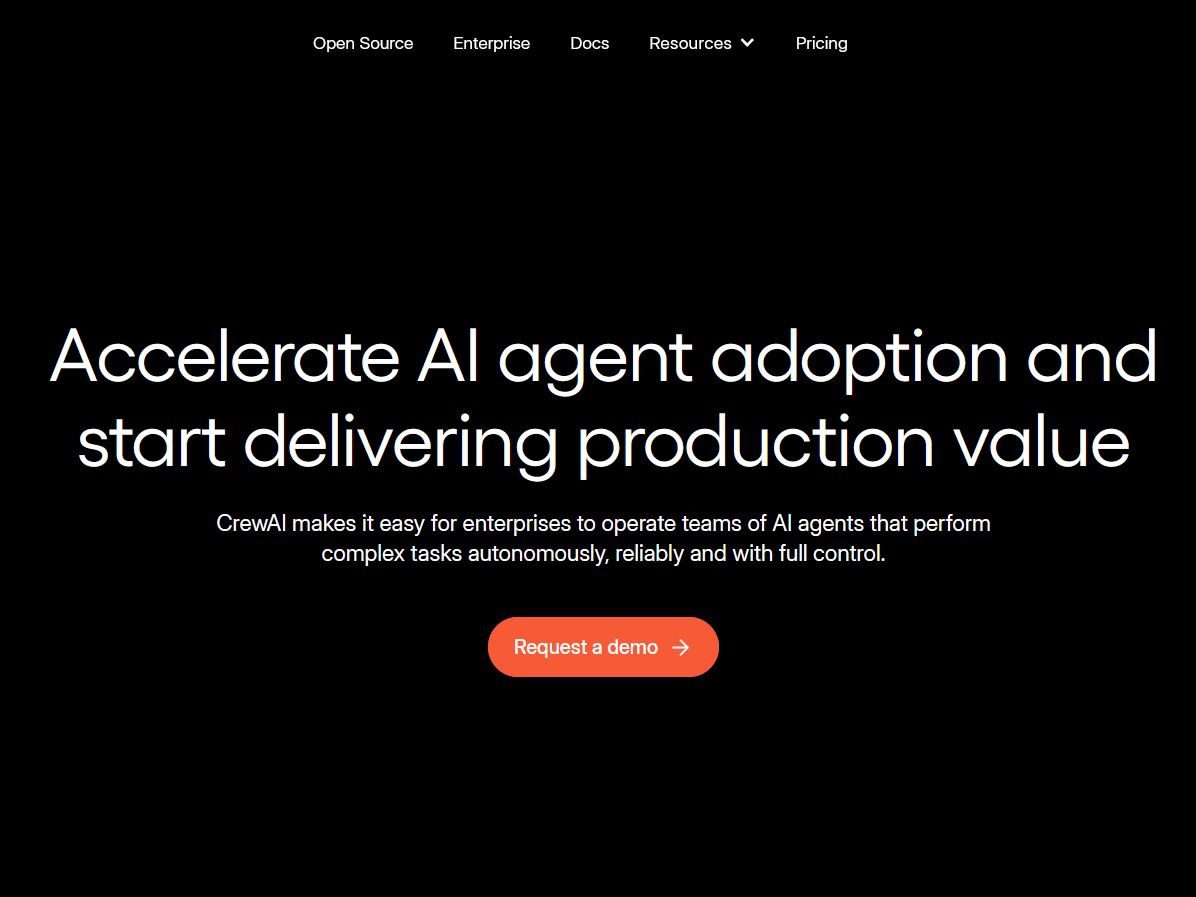
CrewAI is an open-source framework for building teams of AI agents that work together on a task. You define roles, goals, and the tools each agent can use, then chain them so an agent can hand work to the next one. It is a code-first framework: you write Python to define the crew, which gives you control over what each agent does and what it can touch.
The key distinction is roles. Rather than one loop calling one tool, CrewAI lets you assign a writer, a researcher, and a reviewer as separate agents with separate goals and a shared context. That maps well to structured work with a clear division of labour, but it means you design the process before the agents can run it.
The framework is MIT-licensed and has grown into one of the most-starred multi-agent projects on GitHub, alongside LangGraph and AutoGen. The company behind it also runs a hosted platform, but the framework itself stays free to self-host.
Key Features
- Role-based agents — give each agent a role, goal, and backstory, so "researcher" and "writer" are literal Python objects rather than a prompt trick.
- Sequential and hierarchical processes — chain agents in order or let a manager agent delegate to the others.
- Flows — an event-driven pipeline layer added in 2025. Flows own state and execution order while crews do the work inside each step; the docs now recommend Flows for production apps because they handle branching and state more predictably than raw crews.
- Tool integration — plug in search, files, APIs, and custom tools; agents only see the tools you hand them.
- Memory and context sharing — pass state between agents in a crew, and persist memory across runs.
- Python-first — define crews in code for version control and testing, or scaffold a project with the
crewai create flowCLI.
A Typical Workflow
A realistic first project looks like this. You scaffold with crewai create flow, which generates a project with a crew folder and config files. You define each agent (role, goal, backstory, allowed tools) and each task (description, expected output, assigned agent). You then run crewai run from the project root, which detects whether the project is a flow or a plain crew and kicks it off. When the crew runs, each agent completes its task in turn and hands the result downstream; the final task can write a markdown report to disk. If you later want it hosted, crewai deploy create pushes the project to the CrewAI cloud platform, provided the code is in a GitHub repository.
Practical Tips
- Write "expected output" as a contract. The single highest-leverage field on a task is
expected_output. Specify the format ("a markdown report with sections X and Y, 800–1200 words"), and downstream agents get structured input instead of a wall of prose to misread. - Start with two agents, then add a reviewer. Get a researcher-writer pair working on a bounded task before scaling up. Once the loop works, add a third agent whose only job is to critique output against the expected format and fail visibly when it drifts.
- Cap delegation depth. In hierarchical processes a manager agent can keep re-delegating. Set
max_iteron agents and keep the crew small, or one confused agent can burn through tokens in circles. - Check the usage dashboard before blaming the framework. Token spend scales with agent count and steps. If a run costs triple what you expected, look at per-task token counts first; the usual culprit is a verbose context being passed to every downstream agent.
Pricing
The framework is open-source under the MIT licence, so you can self-host and run crews for free, paying only for the model APIs you call. The hosted CrewAI platform (AMP) has a free Basic tier with the visual Studio editor, GitHub integration, and 50 workflow executions per month, plus a custom-priced Enterprise plan adding SSO, RBAC, PII redaction, VPC or on-prem deployment, and onboarding. There is no published self-serve paid tier between free and enterprise. Prices checked September 2026 — see the CrewAI pricing page.
Limitations and Trade-offs
Because it is code-first, the learning curve is higher than a no-code builder. Multi-agent crews can be harder to debug: if the process is badly designed, one agent can pass bad output downstream, and public comparisons consistently note that complex conditional or cyclical workflows fit LangGraph's explicit graph model better. CrewAI has closed much of the observability gap with built-in tracing and OpenTelemetry support, but independent reviews still rate LangSmith's trace replay above it for production debugging. Token spend scales with the number of agents and steps, so a complex crew can get expensive even if the framework itself is free.
What Public Discussion Says
Community write-ups and framework comparisons tend to agree on the pattern. CrewAI is repeatedly described as the fastest route to a working multi-agent prototype, with times of roughly twenty to thirty minutes for a two-agent research-and-write crew cited across several independent comparisons. The role model is praised because non-engineer stakeholders can read the agent definitions. The recurring complaints are about debugging deeper flows, logging that does not propagate cleanly inside task callbacks, and sequential execution being slow for parallelisable work. Use these as directions to test, not as verdicts.
Who Should Use CrewAI?
It fits developers and teams comfortable with Python who want fine control over multi-agent structure, prototyping speed, and a free self-hosted licence. If your workflow is mostly linear or role-shaped, the abstraction matches. If you need cycles with checkpointing and replay, typed state, or first-class production observability, compare LangGraph first. If you cannot write code at all, a no-code platform fits better.
CrewAI vs Alternatives
CrewAI is role-driven and works well when the division of labour is clear. For a lower-level framework with explicit state control, compare LangGraph; for a no-code visual builder, see the CrewAI alternatives guide and the AutoGen alternatives. For orchestration-free agent chat, see AutoGPT.