LangChain
What Is LangChain?
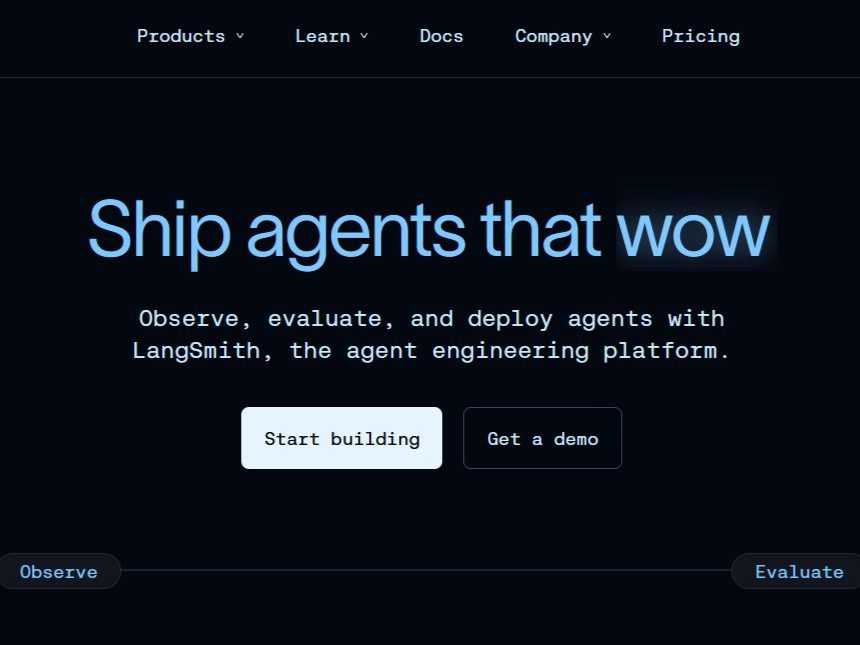
LangChain is the most widely used open-source framework for building applications on top of large language models. It sits below your product and above the model provider, giving you reusable pieces for prompt templates, tool calling, memory, retrieval, and agent loops. Two pieces now live under the same roof: the open-source framework you run yourself, and LangSmith, a hosted platform for tracing, evaluating, and deploying agents.
Choosing LangChain is a decision about control. It is not a managed product you rent; it is a library you import and shape. That means you keep your code, swap providers freely, and can ship to your own infrastructure. The cost is that you own the wiring, the upgrade path, and the debugging when a version bumps break an interface.
LangChain suits teams that already know they want to build their own agent architecture. If you mainly want a chat assistant out of the box, a packaged product will get you there faster.
Key Features
- Composable chains — line up multiple model calls and tool steps into a single pipeline you can test as a unit
- Agent loops — let a model decide which tool to call next and keep going until the task finishes
- Retrieval — plug in vector stores and document loaders for grounded, citeable answers
- Memory and state — persist conversation history and agent context across turns
- LangGraph — graph-based orchestration for stateful, multi-step agents with explicit flow control
- Ecosystem — hundreds of integrations for databases, APIs, and model providers, plus a large community
Pricing
The framework is free and open source under the MIT license, so you never pay to use the code (as of August 2026, it has roughly 145k stars). The money shows up in LangSmith, the hosted observability and evaluation product. Developer costs $0 per seat per month and includes 5,000 base traces a month, then pay-as-you-go. Plus is $39 per seat per month and includes 10,000 base traces a month with unlimited seats. Enterprise is custom pricing for self-hosted or hybrid deployments. Beyond the fixed plans, usage is metered in units: 1 LangChain Compute Unit (LCU) is $1.50 and 1 LangChain Storage Unit (LSU) is $1.00. See the official LangChain pricing page for current numbers.
Limitations and Trade-offs
The framework changes quickly. Interfaces and package names have shifted across major versions, and code written a year ago may need rework. There is also a real learning curve; the abstractions are powerful but not obvious, and beginners can end up with more indirection than a few direct API calls would need. For a small internal tool, the overhead can outweigh the benefit.
Cost is not always free either. LangSmith bills for traces and compute, and a busy production agent can climb past the included quota quickly, so observability spending deserves a budget of its own. And because you assemble the stack yourself, quality control such as evals and guardrails is largely your responsibility rather than the vendor's.
Who Should Use LangChain?
Backend engineers building AI into an existing product get the most out of it, since it drops into code you already control. Data engineers wiring retrieval into an internal assistant benefit from the document and vector-store layer. AI startups that need to differentiate their agent logic on top of commoditized models use it as a foundation. Teams shipping to a private network or regulated environment self-host the framework and LangGraph, rather than sending data to a third party.
It is a poor fit for anyone who wants a finished assistant today or who has no developer to maintain custom code.
LangChain vs Alternatives
LangChain is the general, low-level toolkit; CrewAI builds a higher-level multi-agent framework on the same ideas, so the comparison is less about capability and more about how much structure you want. If you prefer to write orchestration yourself, LangChain gives you the pieces; if you want role-shaped agents that collaborate, CrewAI hands you a ready pattern. For a grounded read on that choice, see our best CrewAI alternatives guide, which maps both open-source and managed options by workflow.